‘Não foi sorte’: teaching chess at the end of Brazil
I spent six weeks teaching chess to kids in Poconé, a small town in Mato Grosso, deep in the Brazilian interior and a world away from anywhere — and beyond the town gives way to the Pantanal, the largest tropical wetland on earth, one of the richest pockets of biodiversity anywhere, and particularly famous for its onças (jaguars). More on those later, because I nearly didn't make it back from my trip into its depths. The chess, though, is the real story — and after a start that had me ready to quit, it became one of the best things I've ever done.
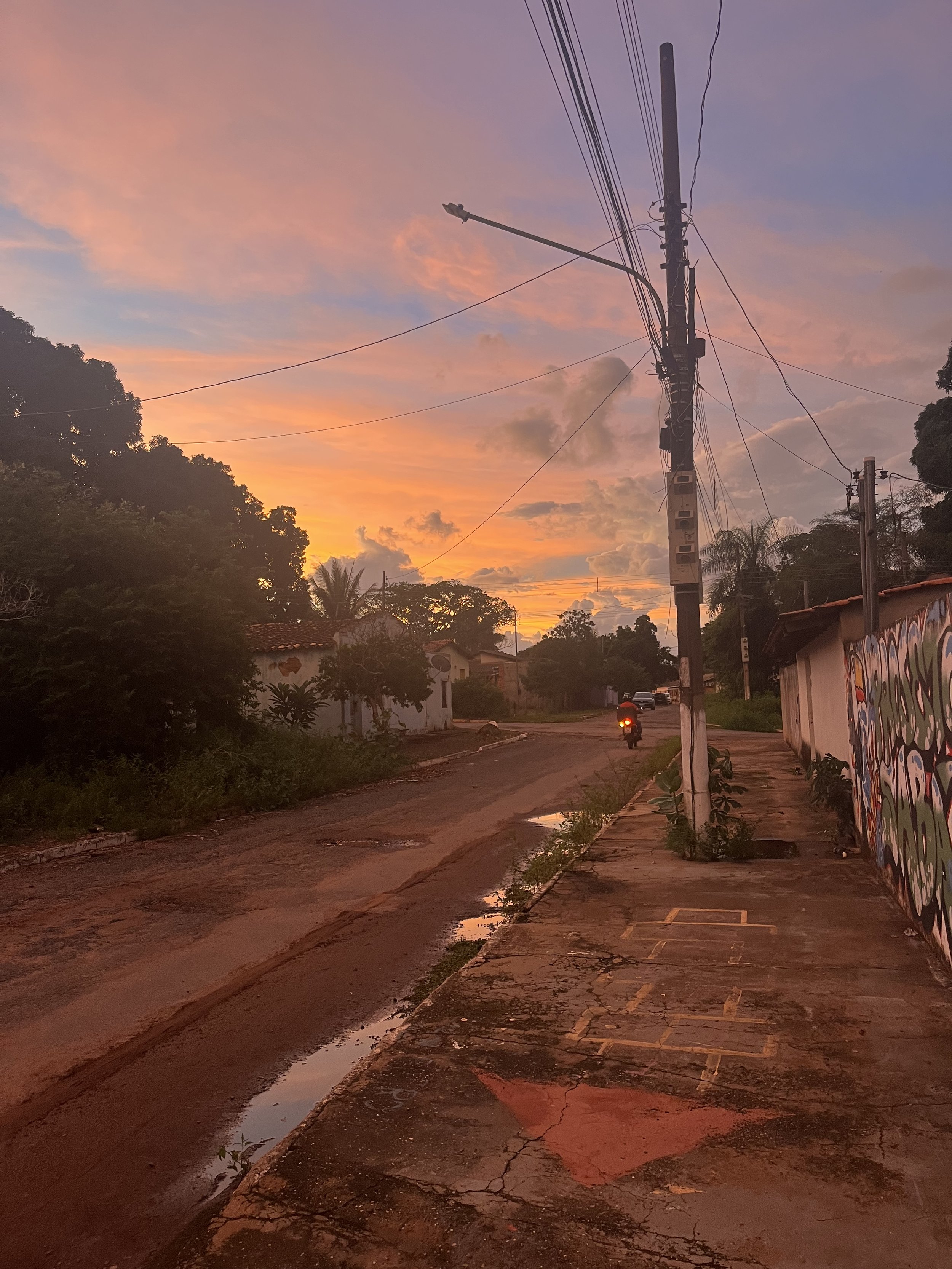
Poconé by night.
Life on the edge
Poconé is slow. People get up with the sun and go to bed early — even on a Friday the whole town is in bed by ten — and each morning at 7am the neighbourhood gathers in Dona Maria's front garden for coffee before work. Her mother did it, and her grandmother before that, going back over a hundred years. Lunch is at Dona Jo's, where for twenty reais (about £3) you eat as much as you like: black beans, barbecued meat in every conceivable form, and farofa (toasted cassava flour) so fresh it ruins all other farofa for you. I'd play a running game with Danielle, one of the waitresses, trying to name the unfamiliar fruits in their delicious juices — I was hopeless. Life moves at its own pace here: some people won't leave the house when it drops to 20 degrees because it's too cold, and a plan is more of a polite suggestion than a commitment. It couldn't feel further from São Paulo, where I'd just been staying with family.
I'd come to volunteer at a community project, and a brilliant one at that. Poconé isn't a place with much on offer for young people — there's little work beyond the local mine, and not a lot to fill the weekends — so the project steps in, running free English classes, capoeira (where I finally learned to do a headstand), football and all sorts of activities for local kids.
It wasn't all postcard-perfect, mind. Thomas, a former volunteer I overlapped with for a day, suggested that of the two beds for volunteers, I take the newer one — pointing at the yellowest mattress I'd ever seen. There was a project dog, Angola, wandering about with some unidentified skin disease, and the whole place ran with very little structure. But I'd come with a gameplan. I'd brought ten chess sets, and I was going to teach the local kids to play.
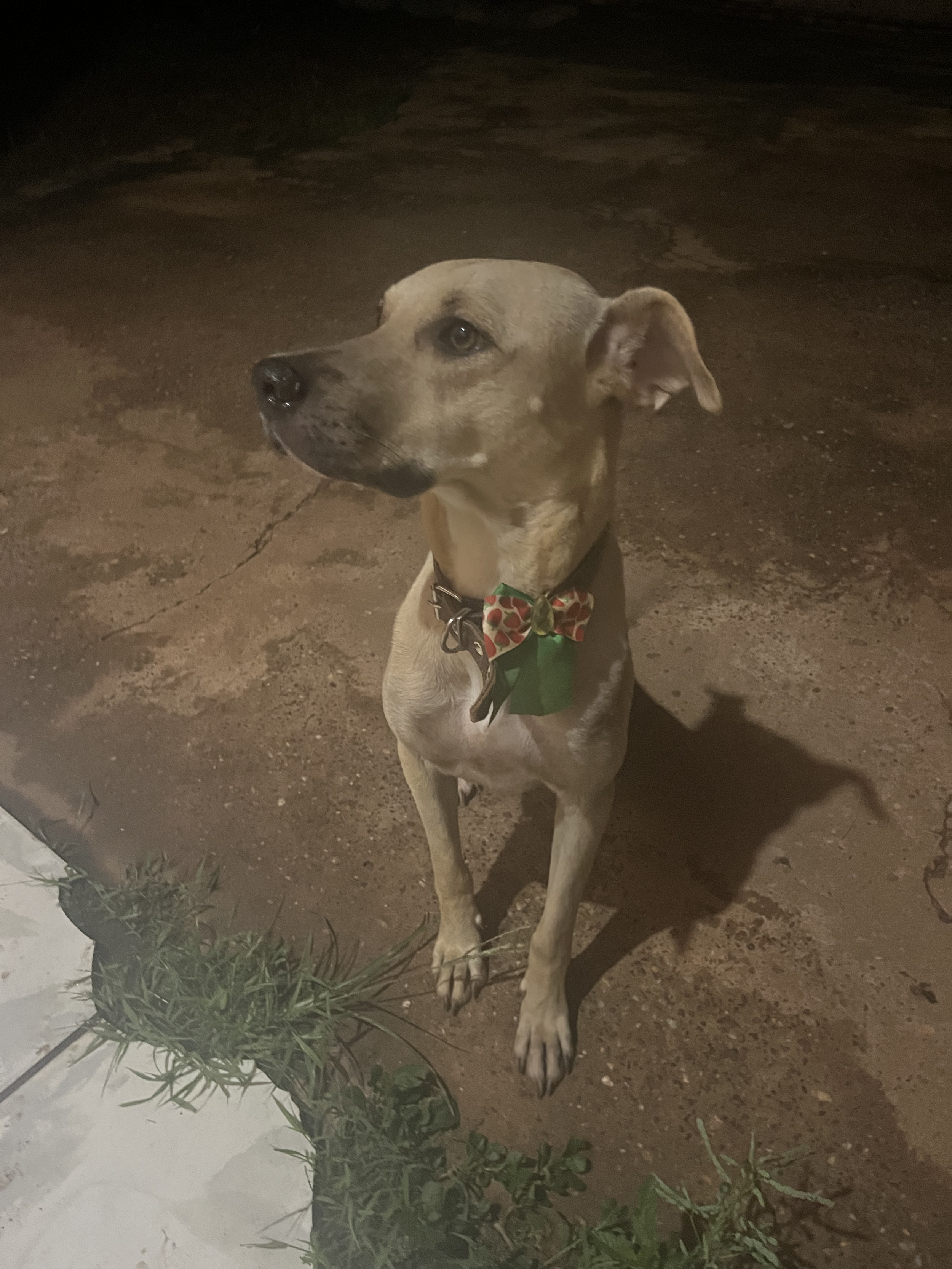
My first friend. Angola.
The flop
It did not start well. Flávio, a great guy who runs the project, was hugely busy: a full-time teacher, getting married, moving house. He'd promised to handle promoting the chess classes, but he didn’t get too far. That's just how it goes here: things start late, arrangements fall through, and a plan is more of a suggestion than a commitment.
I started by putting on four slots for chess classes. At the first, not a single kid showed up. At the second, I got five — twins Bruno and Davi, then Sofia, Saulo and Tiago — all arriving at different times, a mix of ages, a couple who already knew how the pieces moved and others starting from scratch, and some pretty limited attention spans. Three hours, teaching in my second language, trying to hold it together. By the end, Sofia had a good handle of how the pieces moved, and Bruno and Davi had grasped queen-and-rook versus king endings, so it ultimately went better than it felt.
At the third slot, one boy turned up: Rafael, older than the rest, a real talent, who told me that he had nobody to play with. He could give me a proper game, and I taught him everything I could. At the fourth slot, nobody came at all.
So that was the scoreboard after week one — empty, five, one, empty. I'd had such high hopes, and it felt like I'd put a lot in for very little back. On top of that, after making good progress at Portuguese school in São Paulo, I was struggling with the local accent; I was lonely, with no other volunteers around; and there was so little to do in this town at the end of Brazil. I rang my dad back in England and admitted I was finding it really challenging: was this worth it, was it even possible, could I be spending my time in Brazil better? He listened, and then he reminded me why I'd come — that this was a unique opportunity, and that if I set my mind to it I could make it a success. By the end of the call, I'd made up my mind: I was going all in.
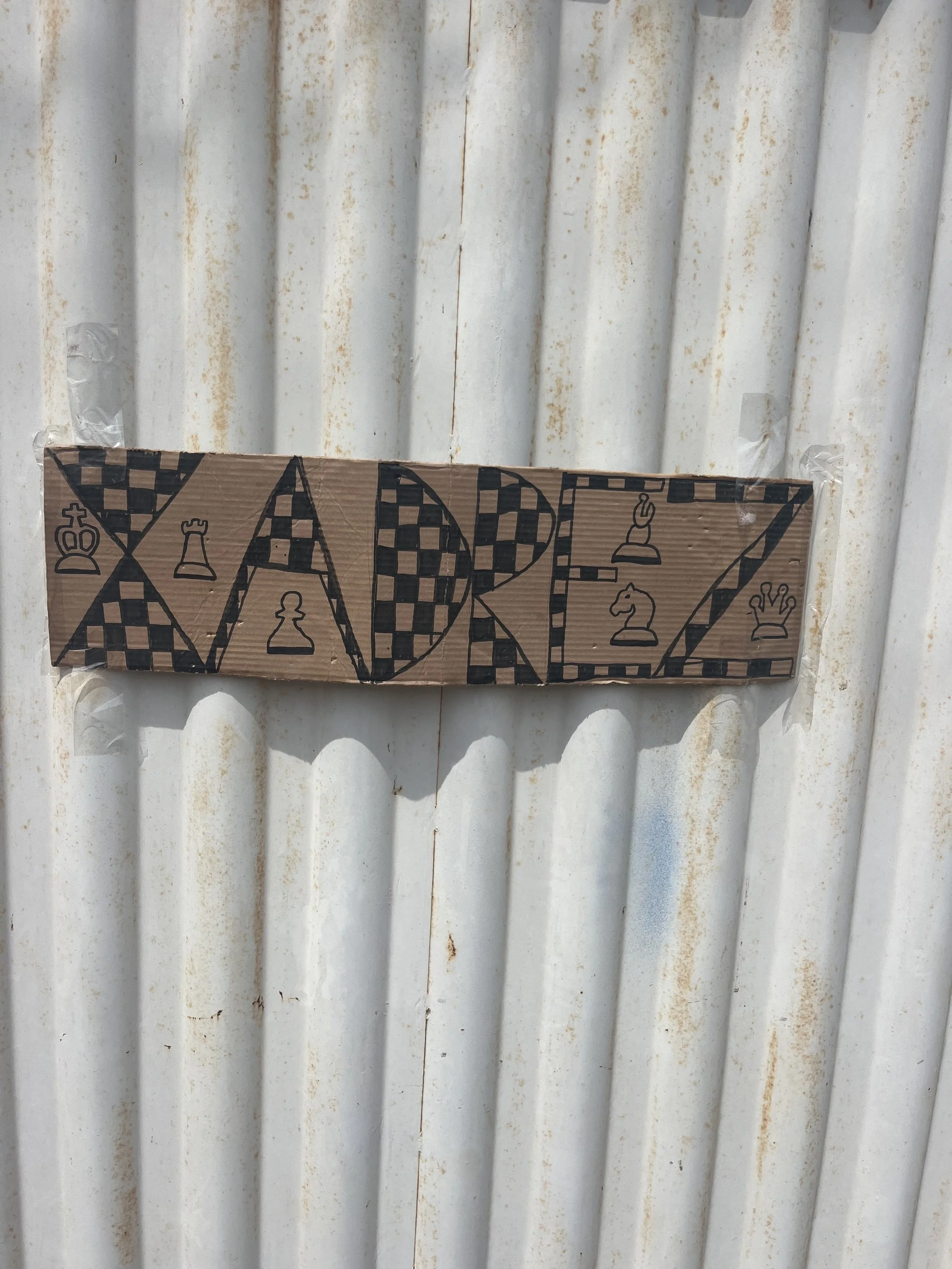
First Day of ‘Clube de Xadrez’.
Doubling down
The first thing I did was call in reinforcements. Thomas, the volunteer I'd overlapped with on day one, was now living in the nearby city, and he generously came back to help me run the classes. Between us it started to feel like a proper thing.
Then I got to work. I made posters and walked them round town, asking shop owners to put them in their windows — and buying something in every single shop along the way, naturally. I talked to anyone who'd listen. I got the local schools to spread the word with parents, which taught me something I hadn't expected: they sent their messages as voice notes, because so many of the parents couldn't read. I started a WhatsApp group with the families, posting daily chess puzzles with cash prizes, fixed sessions for every afternoon so everyone knew the offer, and set a date for a tournament with good prize money to give them all something to aim at.
It took time. But slowly, more and more kids came, and the community began to grow. Rodrigo — whose mum I'd met at a community event — came every single day, first to arrive and last to leave. Saulo picked up the basics frighteningly fast. The twins Bruno and Davi were improving at pace. And then there was Pedro.
Pedro had been a nightmare in that first session, distracting everyone, and I'd honestly thought about asking him not to come back. I only learned his story later. Some of these kids have had desperately hard starts, and Pedro had more than most — a father who was never in the picture, a mother who died when he was young, raised by his grandparents, alcoholic uncle, and older brothers with addiction issues. Flávio told me he'd drifted away from the project entirely, and that the chess had pulled him back in and kept him out of trouble.
Then one Saturday he wandered by the project and we just played — table tennis first, then draughts, then the absolute basics of chess: queen versus eight pawns, Hare and Hounds. With a lot of patience, he got into it.
Not that he played it straight. I had to watch him like a hawk: I'd glance away for a second and my queen would simply have vanished from the board. He'd somehow end up with both bishops on the same colour, or a pawn sitting proudly on the back rank, and when I asked how that had happened he'd protest his innocence to the hilt. If he was losing, he'd try anything — a quiet bit of rearranging, or, failing that, accusing me of cheating. I loved him for it.
He became a regular, got steadily better, and still sends me his games now. That turnaround meant more to me than anything.
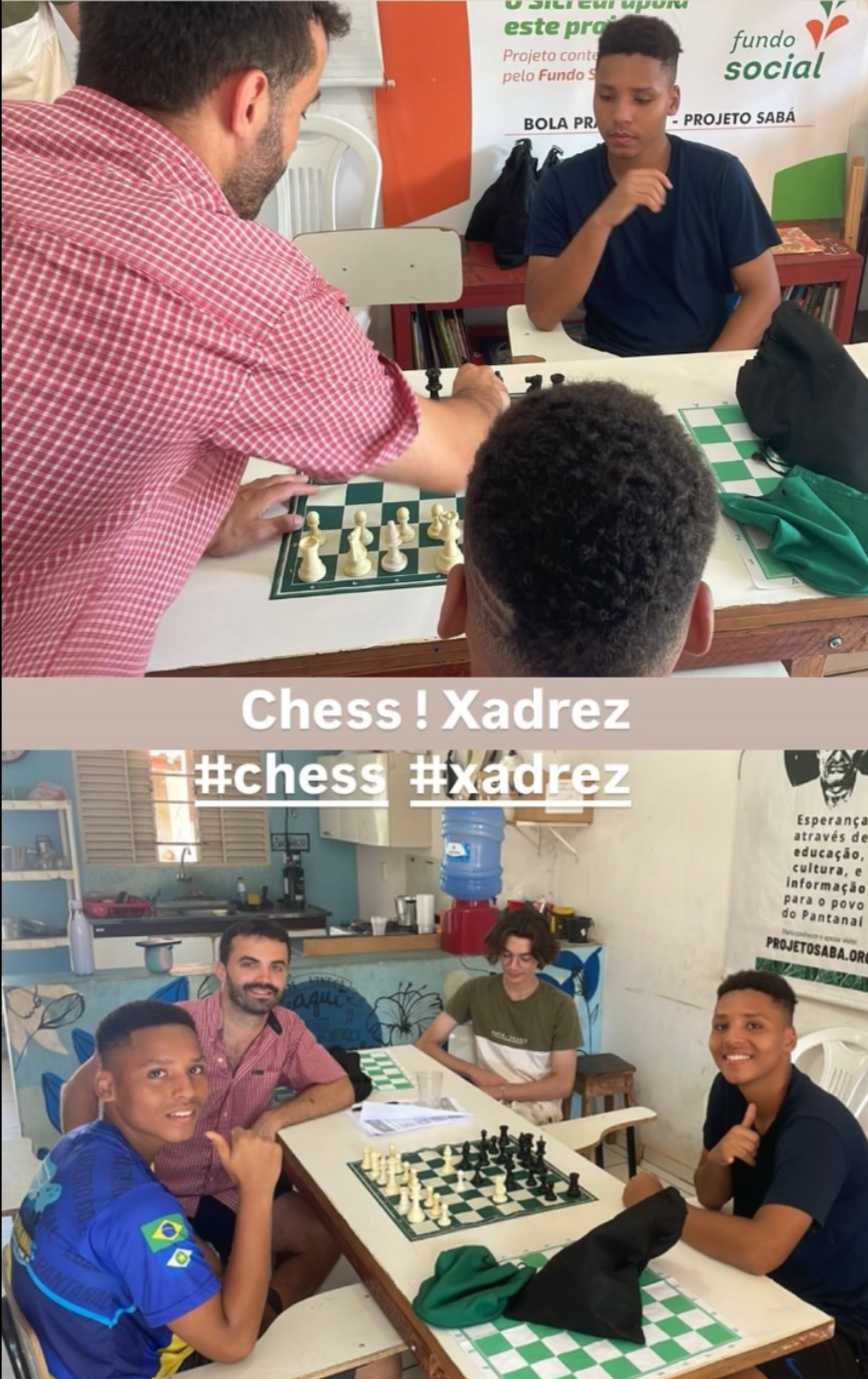
Training.
Tournament day
The tournament became the thing everyone was working towards — the goal that gave the whole effort a point, and the kids couldn't wait. Thomas's lovely girlfriend, Ledilce, offered to bring a beef stroganoff lunch for everyone. Dona Maria would award the prizes.
We'd said a 9:30 start. We got going around 10:15, which by local standards is practically punctual. Twelve kids played, split across two groups. Rafael crushed one, Bruno did very well in the other. In the semis Rafael beat Saulo, and Bruno beat his own twin brother. Then came the final, and a moment I'll never forget: Bruno against Rafael, who'd been winning everything all day with ease. Rafael claimed checkmate. Bruno agreed, and the two of them shook hands — which should have been the end of it, and I should have let it stand. But I asked, "are you sure?" Bruno looked again, spotted he could simply take the rook, and went on to win the whole thing. Incredible. Pedro came fifth, with some lovely checkmates of his own.
The best line of the day came as Bruno was collecting his prizes: his twin Davi, completely deadpan, dropped "não foi sorte, foi estratégia" — a riff on the usual Brazilian "não foi sorte, foi Deus," "it wasn't luck, it was God." His version: “it wasn't luck, it was strategy”. Genius.
The tournament is underway.
Final pant?
One last story, because part of the reason I'd come at all was to see the Pantanal — and Thomas and his girlfriend kindly arranged for us to go. It was a disaster, and I mean that with affection. Heavy rain had wrecked the old dirt road, and we didn't have a proper 4x4, so Ledilce's car promptly began sinking into the mud. I'd been carefully nursing a damaged toe from the football, and the next thing I knew I was barefoot in the muck, surrounded by what felt like hundreds of pernalongas — mosquitoes the size of small birds — that flooded the cabin the second we opened the doors. It took all of us to heave the car free. I remember seeing Ledlice’s leg turn black as it was covered by these pernalongas. We'd then spend the next five minutes desperately squashing the mosquitoes inside; every surface ended up smeared with their blood. This happened five times. The repellent had long since given up, the water was running low, and morale was running very low.
In between, though, the Pantanal showed off: caiman everywhere, and a tapir — this wonderful pre-historic stumpy thing trundling past. At one point a herd of cattle blocked the road; we couldn't stop in case the car got stuck again, so Thomas leaned on the horn to scatter them — and out of the bush came a jaguar, mid-hunt, chasing them down. He hooted again, and we watched this magnificent animal turn and melt back into the foliage. I still wonder, if he hadn't hooted that second time, whether we'd have watched it take a cow down in front of us.
The wonder was short-lived. We got stuck again, in the dark this time, which made being outside the car a great deal more frightening — especially now we knew what was out there. The car this time wouldn't budge and we were genuinely stranded. Time stood still and we were thinking we’d have to spend the night in the car with no water. After an eternity, a lorry of workmen happened to pass — only the second vehicle we'd seen all day — and towed us towards our accommodation. We were bitten half to death and swelling up alarmingly, but we'd survived, and we'd seen an onça in the wild. The worst day of our lives, and one we'll never forget.
The rest of the trip was mercifully uneventful. I saw my first capybara the next morning, took a boat out and watched dozens of birds and a lone caiman. A Greek couple who stayed on the water for twelve hours got a jaguar and an otter for their patience. On the smoother road back we passed two toucans, more birds and lizards — and I arrived home, dreaming of a shower and my bed, to find the new volunteer, Rafid, had locked me out of the room and left the city with our key. A fitting end.
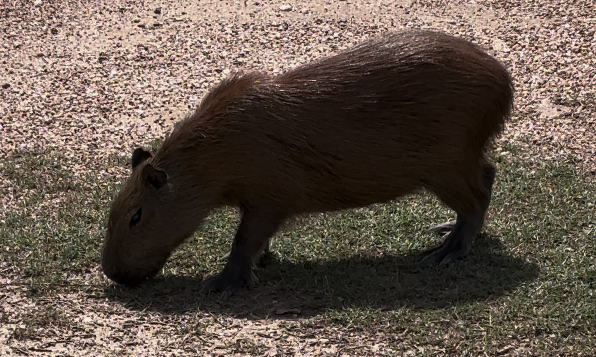
A capybara.
Reflections
Teaching chess in a second language to a room of kids with wildly different levels and backgrounds is genuinely hard. Some sessions I left drained. But Poconé taught me that the wins are slow, and rarely the ones you expect — they're the kid who had nobody to play with, or the one you nearly gave up on who now won't stop sending you his games.
I'm writing this with some sad news fresh in my mind: I recently learned that Dona Maria has passed away. She was the beating heart of that neighbourhood — an absolute legend, and made me feel so welcome. Our Queen will not be forgotten.
She understood something I only really grasped out there. Chess didn't change these kids' circumstances. What it gave them was something regular, something that was theirs, a reason to turn up and a glimpse of a slightly wider world — and a community to share it with. Ten chess sets and a stack of homemade posters turned out to be worth far more than the sum of their parts. That was worth everything — and, on balance, worth very nearly being eaten in a swamp.
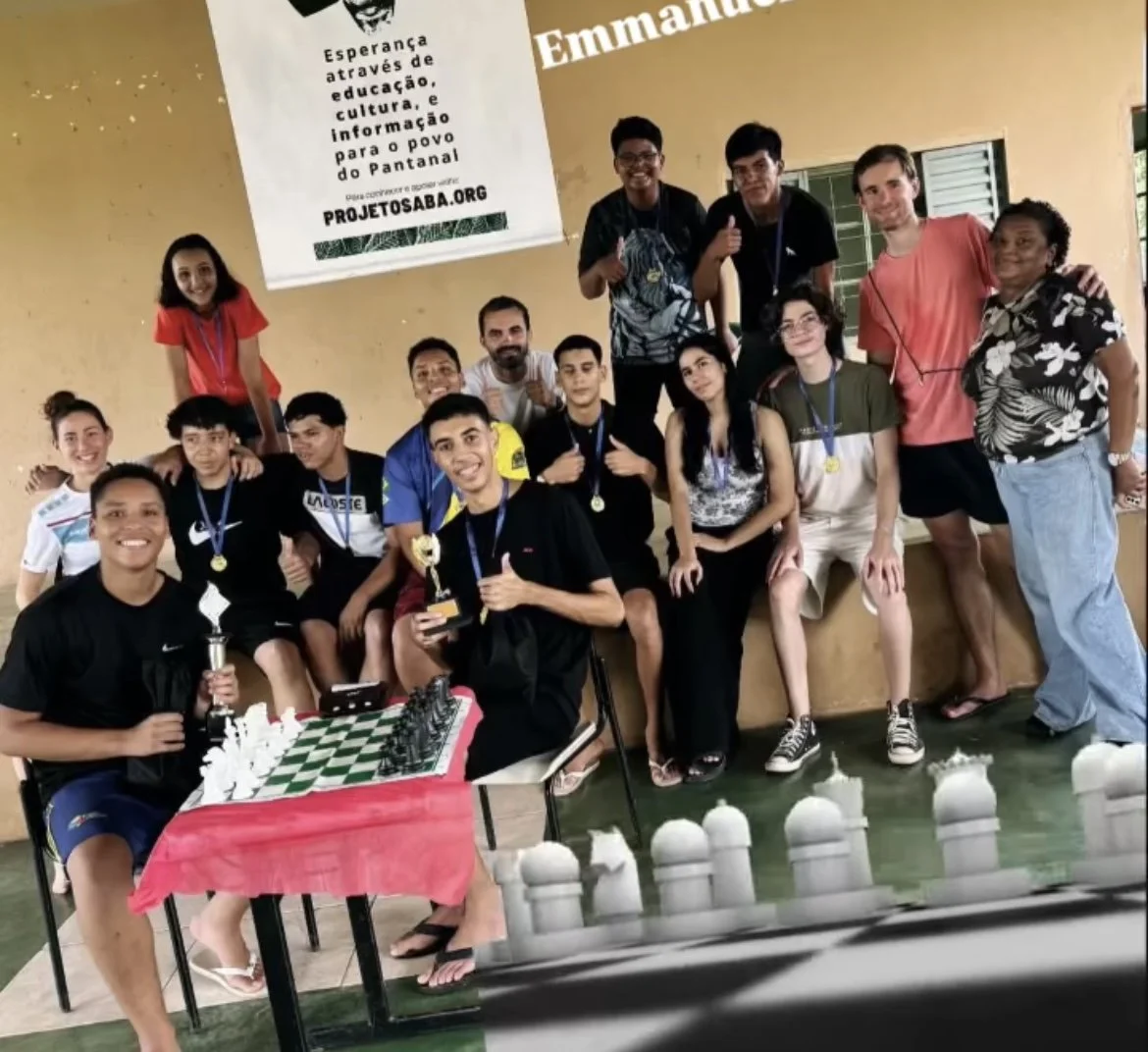
Final wrap up.